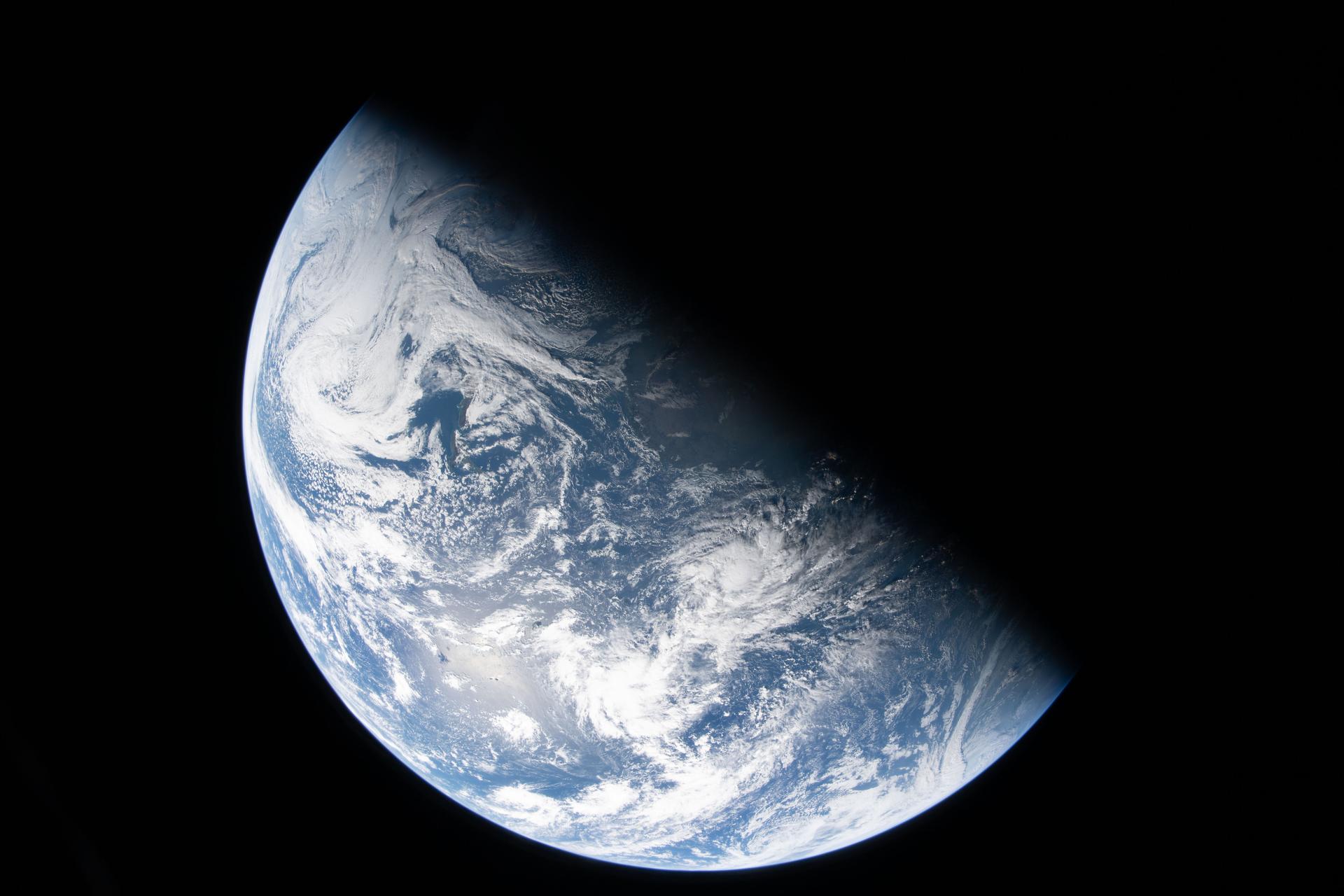
Photo of Earth. AP Physics II Final Project

Apollo 13 vs Artemis II

The Successful Failure vs The New Frontier

Liam Fries _

The Missions

Apollo 13 and Artemis II are two lunar missions separated by over five decades of technological development.
Apollo 13 insignia.

Apollo 13

On April 11th, 1970, Apollo 13 launched aboard a Saturn V rocket with the intent to become humanity's third crewed lunar landing mission. Apollo 13 became known as the successful failure after an oxygen tank explosion forced the crew to abort their mission and instead focus on returning home alive. News of the incident quickly spread around the globe and had millions of eyes hooked to television screens during the crew's time-critical return.
Artemis 2 Patch.

Artemis II

Fifty-six years after the Apollo 13 mission, on April 1st 2026, Orion, the spacecraft for the Artemis II mission, launched. Orion signified the first human craft in over fifty years to venture into deep space, with the last being Apollo 17 in 1972.
1. Orbital Mechanics

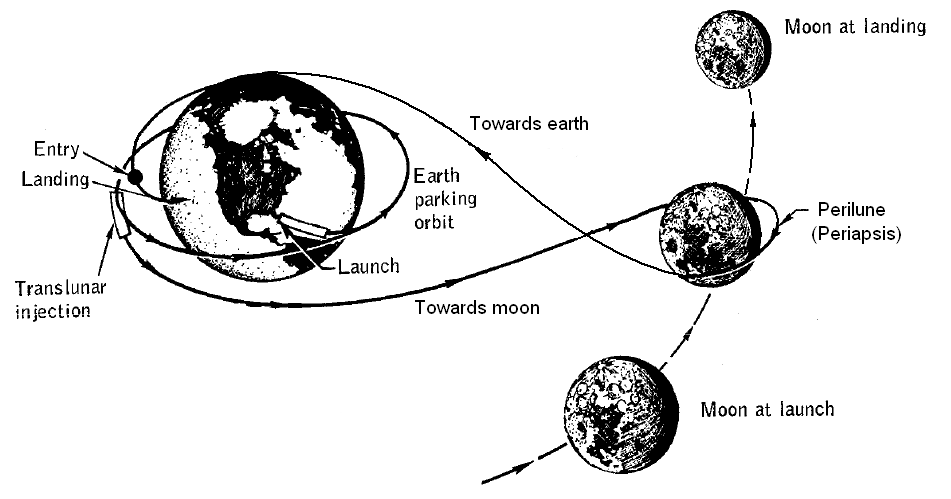
Both Apollo 13 and Artemis II used a free-return trajectory to return to Earth.

A free-return trajectory is the path a spacecraft takes around the Moon and back to Earth in order to minimize the fuel needed. The trajectory relies mostly on gravity for natural propulsion.


The total specific orbital energy, \( \epsilon \), of a spacecraft can be represented by:

$$ \epsilon = K + U_g $$ $$ \epsilon = \frac{1}{2}mv^{2} - \frac{GM_em}{r} $$

As seen above, the gravitational potential energy, \( U_g \), is proportional to \( 1/r \) indicating that Earth's gravitational potential energy decreases in magnitude as the spacecraft moves farther from Earth. Earth's gravitational force significantly decreases as it is proportional to \( 1/r^2 \) from Newton's Law of Gravitation:

$$ F_g = \frac{GM_em}{r^2} $$

For both Apollo 13 and Artemis II, the gravitational force due to the Earth would only be a small fraction of the force at Earth's surface due to the \( r^2 \) term in the denominator. The decrease in gravitational force with distance was essential for the missions, since the spacecraft relied on the combined gravitational interaction of the Earth and Moon rather than continuous propulsion.


Free return trajectory diagram.

2. Thermodynamics & Energy

During reentry, spacecraft returning from the moon travel approximately at \( 1.1 \cdot 10^4 \, \mathrm{m/s} \). At such speeds, the spacecraft possesses enormous amounts of kinetic energy that needs to be dissipated for a safe landing.


Nearly all of this kinetic energy is dissipated as thermal energy during reentry. The thermal energy or heat, \( Q \), can be represented with the following equation derived from the conservation of energy:

$$ \Delta K + \Delta U + Q = 0 $$

Therefore, the kinetic energy dissipated by heat is:

$$ Q = -(\Delta K + \Delta U) $$

Where \( \Delta K \) and \( \Delta U \) are:

$$ \Delta K = \frac{1}{2}m( {v_f}^2 - {v_0}^2 ) $$ $$ \Delta U = - \frac{GM_em}{r_f} + \frac{GM_em}{r_0} $$

To account for this heat energy, both Apollo 13 and Artemis II used ablative heat shields designed to absorb and dissipate heat. Orion's heat shield was significantly larger than the Apollo Command Module's with improved heat dissipation techniques.


From the equation for \( Q \) above, the heat dissipated from Artemis II between when it entered Earth's atmosphere and deployed parachutes is approximately:

$$ Q = 5.7475 \cdot 10^{11} \, \mathrm{J} $$

3. Life Support Engineering

Carbon Dioxide Scrubbers

One of the most dangerous incidents in the Apollo 13 mission was the buildup of toxic carbon dioxide, \( \mathrm{CO}_2 \), inside the Lunar Module. The Lithium Hydroxide canisters (\( \mathrm{CO}_2 \) scrubbers) in the Command Module were square canisters while the ones in the Lunar Module used round canisters, leading to the Square Peg in a Round Hole crisis.


Quickly, engineers on Earth developed a makeshift \( \mathrm{CO}_2 \) scrubber using resources aboard the spacecraft such as cardboard and plastic bags. Without the improvised scrubber, the astronauts would likely have been killed before landing.


Artemis II addressed this problem by implementing an Amine Swingbed system for removing carbon dioxide and humidity from the modules. The Amine Swingbed system continuously operates while avoiding the need for a replacement through the use of dual beds. One bed filters the air while the other regenerates allowing for a continuous cycle.


The switch from Apollo 13's disposable \( \mathrm{CO}_2 \) scrubbers to Artemis II's regenerative system shows how the Apollo 13 incident has influenced future space missions in their pursuit for interplanetary travel.


Electrical Energy

Apollo 13 relied on oxygen-fuel cells for power. And while efficient, much of the system went down with the explosion of the oxygen tank, causing a hindrance the spacecraft's power generation abilities.


Artemis II took a different approach, employing large solar arrays to convert light directly into electrical energy. The solar arrays use the photovoltaic effect to implement this.

The Evolution of Spacecraft Safety

Apollo 13 demonstrated that survival in space depends on critical real-time problem solving skills rather than on preparation alone.


Artemis II integrated many features based on the lessons learned from the Apollo 13 mission:


Despite the increased safety of modern spacecraft, small failures can still quickly lead to life-threatening situations for the astronauts isolated in deep space.

Comparison

Category Apollo 13 Artemis II
Launch Vehicle Saturn V Space Launch System (SLS)
Spacecraft Apollo Command Module Orion Capsule
Crew Size \( 3 \) \( 4 \)
Maximum Distance \( 400,171 \, \mathrm{km} \) \( 406,771 \, \mathrm{km} \)
Power Source Fuel Cells Solar Wings
Life Support Disposable CO2 Canisters Regenerative Amine Swingbeds
Distance Traversed \( 1,001,440 \, \mathrm{km} \) \( 1,126,922 \, \mathrm{km} \)
Mission Duration \( 5 \) days and \( 22.9 \) hours \( 9 \) days and \( 1.5 \) hours

Conclusion

Apollo 13 proved the importance of physics, engineering, and real-time problem solving in deep space missions. Artemis II showed how modern spacecraft evolved from the lessons learned during Apollo 13, and other previous missions.


Both the Apollo 13 mission and the Artemis II mission demonstrate the importance of preparation across many different areas needed for safe space exploration.

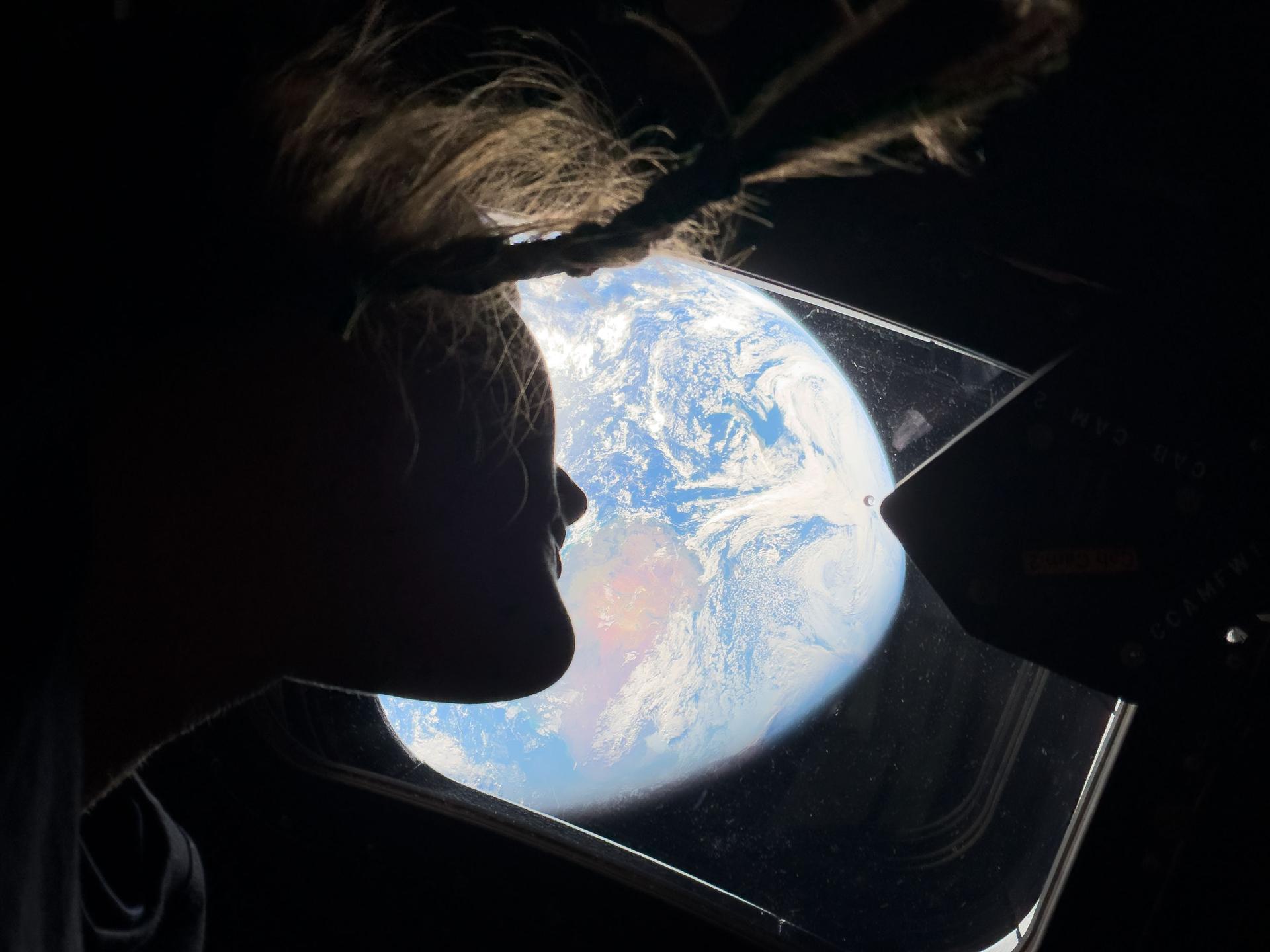
Christina Koch peering at Earth through Orion.